
Legal Advice by SR Law Solutions
Introduction
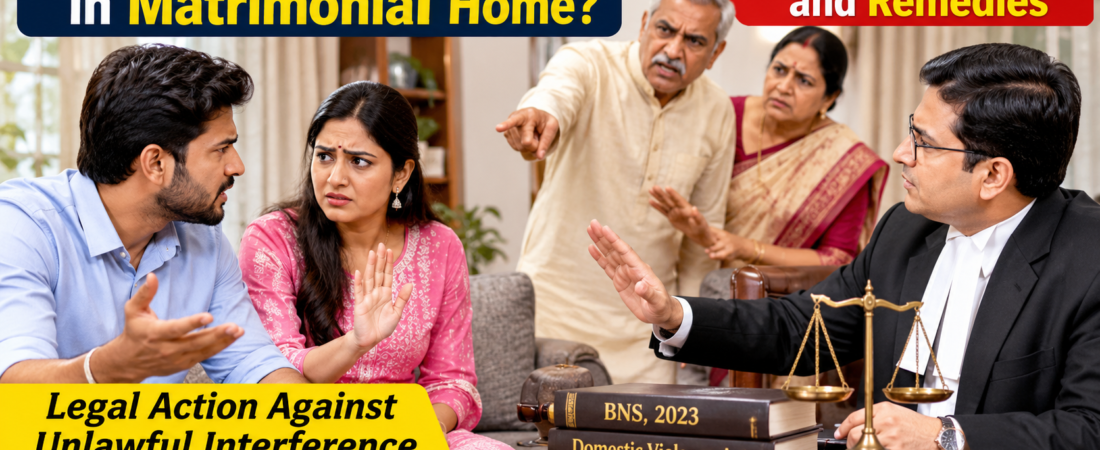
Marriage is a relationship between two individuals and their families. However, sometimes disputes arise when the wife’s parents or maternal family members unnecessarily interfere in the matrimonial life of the couple. Such interference may create serious problems between husband and wife and disturb the peace of the matrimonial home.
If the wife’s family members repeatedly visit the matrimonial home, threaten the husband or his family, create disputes, abuse family members, use physical force or unlawfully disturb the household, legal remedies may be available under Indian law.
This article explains the legal rights of the husband and his family members and the remedies available against unlawful interference by the wife’s maternal family.
1. When Does Interference Become a Legal Offence?
Every family member has the right to maintain relationships and communicate with their relatives. Merely visiting the daughter’s matrimonial home or trying to resolve a marital dispute is not a criminal offence.
However, legal action may arise where there is evidence of:
- Threatening the husband or his family members.
- Physically assaulting or abusing family members.
- Forcibly entering or unlawfully remaining in the matrimonial house with the intention specified by law.
- Creating disturbances through criminal intimidation.
- Intentionally provoking a breach of peace.
- Damaging household property.
- Using force or unlawful methods to threaten family members.
The exact legal consequences depend on the facts and evidence of each incident.
2. Important Legal Sections Under Bharatiya Nyaya Sanhita (BNS), 2023
The following provisions may apply depending on the nature of the alleged conduct:
Section 329 BNS – Criminal Trespass and House Trespass
If a person enters or unlawfully remains in another person’s possession with the intention to commit an offence or intimidate, insult or annoy the person in possession, the provision may apply.
Section 351 BNS – Criminal Intimidation
If a person threatens another person with injury to their body, reputation or property with the intention of causing alarm or compelling them to act against their legal rights, this provision may apply.
Section 115 BNS – Voluntarily Causing Hurt
Where a person intentionally causes bodily pain or injury to another person, this provision may apply.
Section 131 BNS – Assault or Criminal Force
Where a person assaults or uses criminal force against another person, this provision may apply.
These provisions cannot be invoked merely because a family dispute exists. Their essential legal ingredients must be established.
3. Legal Rights of Husband and His Family
A husband and his family members also have legal rights, including:
- Right to personal safety and dignity.
- Right to protection against criminal threats.
- Right to peaceful enjoyment of property and lawful possession.
- Right to approach the police against unlawful acts.
- Right to seek appropriate legal remedies before a competent court.
No person should take the law into their own hands or use force to settle a matrimonial dispute.
4. What Legal Action Can the Husband Take?
If the wife’s maternal family members repeatedly create unlawful disturbances, the husband may consider the following steps:
- Submit a written complaint to the concerned police station.
- Preserve CCTV footage, photographs, call recordings and messages, subject to applicable law.
- Collect medical documents in case of physical assault.
- Identify independent witnesses to the incident.
- Send a legal notice where appropriate.
- Approach the competent court for suitable civil or criminal remedies.
- Seek appropriate preventive assistance from the authorities where there is a genuine apprehension of breach of peace.
The legal action should be based on genuine incidents and supporting evidence.
5. Can a Legal Notice Be Sent to the Wife’s Parents?
Yes. Where there is a genuine legal grievance, an advocate may send a legal notice to the concerned persons.
The notice may require them to:
- Stop making unlawful threats.
- Refrain from assault or harassment.
- Avoid unlawful interference with peaceful possession.
- Stop damaging property.
- Resolve disputes through lawful means.
A legal notice should describe actual incidents, dates, persons involved and available evidence. It cannot create a criminal offence merely by making allegations.
6. Important Protection Available to the Wife
It is equally important to understand that a married woman has independent legal rights.
Under Section 17 of the Protection of Women from Domestic Violence Act, 2005, an aggrieved woman in a domestic relationship has a right to reside in the shared household, irrespective of whether she has ownership rights in that property.
Therefore, a husband or his family cannot lawfully exclude or evict a wife from her shared household except in accordance with law.
The wife’s parents also have the right to provide lawful support and assistance to her. The law does not prohibit genuine family support.
7. Why Legal Advice Is Important in Matrimonial Disputes
Matrimonial disputes require careful legal handling. Wrongful allegations, threats, physical confrontation or illegal eviction may create further criminal and civil litigation.
Before taking any action, it is advisable to consult an experienced matrimonial and criminal lawyer who can examine the facts, evidence and applicable legal provisions.
Conclusion
Unlawful interference, threats, physical violence and intimidation by relatives of either spouse should not be encouraged. Every person has the right to dignity, safety and peaceful family life.
However, every matrimonial dispute must be examined fairly. Legal remedies should be used only where the facts establish a genuine legal cause of action.
SR Law Solutions provides legal consultation and assistance in matrimonial disputes, criminal defence, domestic violence matters, family disputes, legal notices and court proceedings.
Contact SR Law Solutions
Advocate Rakesh Kumar Rana
Advocate Savita Rana
District & Sessions Court, Chamber No. 1024, 2nd Floor, New Building, RDC Raj Nagar, Ghaziabad.
Phone: 8750070969 / 8920122669
Website: https://srlawsolutions.in/
Your Rights, Our Responsibility.
Disclaimer: This article is for general legal awareness and does not constitute case-specific legal advice. Legal provisions and remedies depend on the facts and evidence of each case.