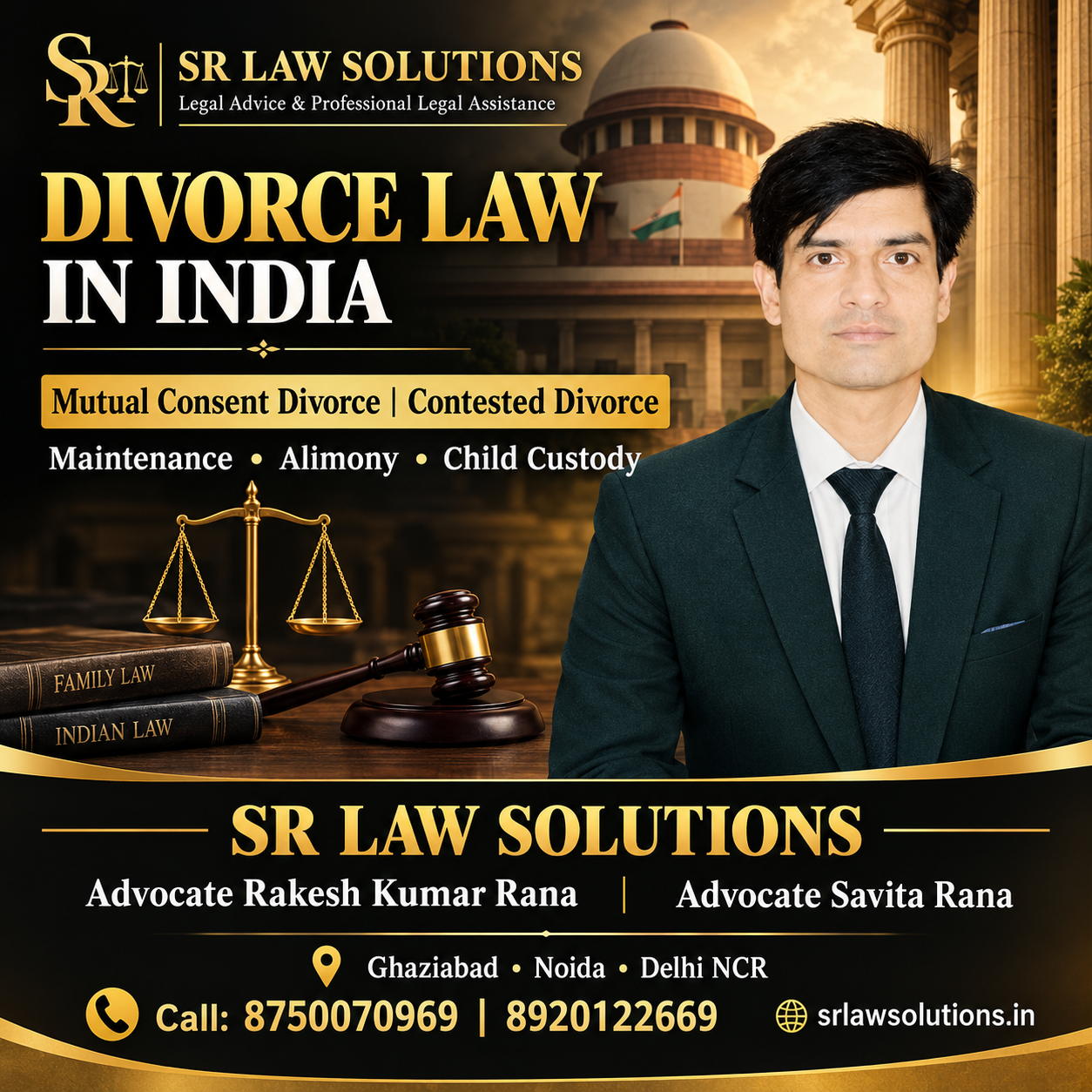
Published by: SR Law Solutions | Legal Advice & Professional Legal Assistance
Introduction
Divorce is a legal process through which a marriage is dissolved by a competent court. When a marriage faces serious differences, cruelty, desertion, or other legally recognized grounds, understanding the applicable divorce law can help individuals make informed decisions about their future.
SR Law Solutions provides legal assistance relating to divorce cases, mutual consent divorce, contested divorce, alimony, maintenance, child custody, domestic violence matters, and matrimonial disputes in Ghaziabad, Noida, Delhi NCR, and other jurisdictions, subject to applicable law and court jurisdiction.
If you are searching for a divorce lawyer in Ghaziabad, the best divorce advocate near me, a matrimonial lawyer in Noida, or a Supreme Court Advocate for matrimonial disputes, understanding the legal process is an important first step.
Types of Divorce in India
1. Mutual Consent Divorce
Mutual consent divorce is an option when both spouses agree to dissolve their marriage and settle related issues.
Under Section 13B of the Hindu Marriage Act, 1955, eligible Hindu couples can seek divorce by mutual consent, subject to the statutory requirements.
The process may involve:
- Filing a joint divorce petition.
- Addressing maintenance or permanent alimony.
- Deciding child custody and visitation arrangements, where applicable.
- Settlement of financial and other matrimonial disputes.
- Completion of the applicable court proceedings.
The statutory waiting period may be waived by the court in appropriate cases, depending on the facts and applicable legal principles. A divorce decree is granted by the court, not merely by signing a settlement.
2. Contested Divorce
A contested divorce arises when one spouse seeks dissolution of the marriage and the other spouse does not agree, or the parties dispute the grounds or terms of divorce.
Depending on the applicable marriage law, legally recognized grounds may include:
- Cruelty.
- Desertion, where statutory conditions are met.
- Adultery, as a matrimonial ground where applicable.
- Certain legally specified circumstances relating to conversion, mental disorder, or other statutory grounds, where applicable.
The court considers the pleadings, evidence, applicable law, and circumstances of the case before passing an order.
3. Maintenance and Alimony
Financial support may be an important issue during or after matrimonial proceedings. Depending on the applicable law and facts, a spouse may seek interim maintenance, permanent alimony, or other appropriate relief.
Courts may consider factors such as income, financial resources, reasonable needs, liabilities, and the circumstances of both parties.
4. Child Custody and Visitation
Where children are involved, the court considers their welfare and best interests while deciding custody, guardianship, and visitation arrangements. Relevant factors may include the child’s needs, safety, education, age, and the circumstances of the parents.
Important Divorce Laws in India
The applicable law depends on the parties’ circumstances and the law governing their marriage. Important statutes may include:
- Hindu Marriage Act, 1955 – Sections 13 and 13B, where applicable.
- Special Marriage Act, 1954 – provisions relating to divorce and divorce by mutual consent, where applicable.
- Family Courts Act, 1984 – provisions concerning Family Courts.
- Applicable maintenance and domestic violence laws, depending on the relief sought and the facts of the case.
Important: The correct legal provision must be selected after examining the marriage, facts, jurisdiction, and relief required. No single divorce procedure applies to every marriage in India.
Why Consult a Divorce Lawyer?
A qualified matrimonial lawyer can assist with:
- Drafting and filing divorce petitions.
- Mutual consent divorce documentation.
- Contested divorce proceedings.
- Maintenance and alimony claims.
- Child custody and visitation matters.
- Domestic violence and related matrimonial proceedings.
- Settlement negotiations and legal notices.
- Appeals and appropriate proceedings before higher courts, where legally maintainable.
Professional legal advice can help you understand your rights, obligations, available remedies, and the documents required for your case.
Divorce Lawyer in Ghaziabad, Noida & Delhi NCR
SR Law Solutions offers legal assistance in matrimonial and family law matters, including divorce, maintenance, child custody, domestic violence, and matrimonial settlements.
Advocate Rakesh Kumar Rana
Advocate Savita Rana
SR Law Solutions
District and Sessions Court, Chamber No. 1024, 2nd Floor, New Building, RDC Raj Nagar, Ghaziabad, Uttar Pradesh.
Contact: 8750070969
Contact: 8920122669
Email: srlawsolutions@gmail.com
Website: https://srlawsolutions.in/
For legal consultation, contact the office to discuss your case and the appropriate legal remedies.
Frequently Asked Questions (FAQs)
Q1. Can a couple obtain a mutual consent divorce in India?
Yes. Eligible couples may apply under the applicable law, such as Section 13B of the Hindu Marriage Act, 1955, or the relevant provisions of the Special Marriage Act, 1954.
Q2. Is a six-month waiting period mandatory in every mutual consent divorce?
Not necessarily. The court may waive the waiting period in appropriate cases under the applicable legal principles. Waiver is not automatic.
Q3. Can a wife claim maintenance during divorce proceedings?
A spouse may be eligible to seek maintenance under the applicable law, depending on the facts, financial circumstances, and statutory requirements.
Q4. Which court handles divorce cases?
Depending on the location and applicable law, a Family Court or another competent court with jurisdiction may hear the matter.
Q5. Can child custody be decided during divorce proceedings?
Yes. The competent court can consider custody and visitation issues, with the child’s welfare as a primary consideration.
Conclusion
Divorce is a significant legal decision that can involve personal, financial, and parental responsibilities. Understanding the applicable matrimonial law and obtaining appropriate legal guidance can help individuals navigate the process more effectively.
For assistance with mutual consent divorce, contested divorce, alimony, maintenance, child custody, and matrimonial disputes in Ghaziabad, Noida, Delhi NCR, and other appropriate jurisdictions, contact SR Law Solutions for case-specific legal consultation.
Legal Disclaimer: This article is for general informational purposes only and does not constitute legal advice. Outcomes and procedures depend on the applicable law and individual facts. No particular result or timeline is guaranteed.
SEO Keywords
Divorce Lawyer in Ghaziabad, Best Divorce Advocate in Ghaziabad, Divorce Lawyer in Noida, Matrimonial Lawyer in Delhi NCR, Supreme Court Advocate India, Mutual Consent Divorce Lawyer, Contested Divorce Advocate, Family Court Lawyer Ghaziabad, Divorce Petition Lawyer, Hindu Marriage Act Section 13B, Divorce Legal Advice, Alimony Lawyer, Maintenance Case Lawyer, Child Custody Lawyer, Domestic Violence Lawyer, Matrimonial Dispute Lawyer, Divorce Advocate Near Me, SR Law Solutions, Advocate Rakesh Kumar Rana, Advocate Savita Rana.